

If you are replacing an aging HVAC system, the heat pump vs furnace decision can affect how your home heats, cools, and uses energy for years. For many Central Texas homes, a heat pump is worth serious consideration because one system can provide both cooling and heating. A furnace can still be the right fit when the home already has compatible equipment, the homeowner prefers furnace-style heat, or the fuel and installation setup make it the more practical choice.
There is no universal winner. The better option depends on your current HVAC equipment, fuel availability, electrical capacity, ductwork, comfort preferences, budget, and how the system is sized for your home.
Quick answer For many Central Texas homes, a properly selected heat pump can be an efficient year-round option because the region has a long cooling season and generally lighter heating demand than colder northern climates. A furnace remains a strong heating option, especially when an existing gas system is in good condition or the home is better suited to a furnace or dual-fuel setup. |
Heat Pump vs. Furnace: What Is the Main Difference?
The biggest difference is how each system provides heat. A heat pump transfers heat from one place to another. In cooling mode, it moves heat from inside your home to the outdoors. In heating mode, it reverses that process and moves heat from the outdoor air into your home. The U.S. Department of Energy describes heat pumps as systems that transfer heat rather than generate it, which is why they can provide both heating and cooling from one piece of HVAC equipment.
A furnace produces heat and then uses the blower and duct system to distribute that heated air through the home. Furnaces can use natural gas, propane, oil, or electricity depending on the equipment and the home.
How a Heat Pump Works
A central air-source heat pump looks similar to a traditional outdoor AC condenser, but it can reverse the refrigerant cycle. In summer, it operates much like an air conditioner. In winter, it extracts available heat from outside air and transfers that heat indoors. Modern equipment can continue operating in cold weather, although capacity and efficiency vary by model and outdoor temperature.
How a Furnace Works
A furnace is dedicated to heating. A gas furnace burns fuel in a controlled combustion process and transfers that heat to the home’s air stream; an electric furnace uses electric resistance elements. The furnace does not provide cooling, so homes with a furnace normally rely on a separate central AC or heat-pump component for summer comfort.
Heat Pump vs. Furnace at a Glance
| Factor | Heat Pump | Furnace |
|---|---|---|
| Heating | Yes | Yes |
| Cooling | Yes | No – needs separate cooling equipment |
| How it heats | Transfers heat | Generates heat |
| Typical energy source | Electricity | Gas, propane, oil, or electricity |
| Central Texas fit | Often a strong year-round option | Also viable, especially with existing compatible systems |
| Cold-weather strategy | Model-dependent; may use auxiliary or backup heat | Strong dedicated heating output |
| Best comparison moment | When replacing AC or the full HVAC system | When replacing heating equipment or retaining an existing fuel setup |
Are Heat Pumps Good in Texas?
For homeowners asking whether heat pumps are good in Texas, the answer is often yes – but Texas is large enough that climate and system design still matter. Central Texas has a long cooling season, relatively moderate heating demand compared with many northern climates, and occasional hard freezes. That combination makes year-round heat-pump operation appealing for many homes, provided the equipment is properly selected and sized.
A heat pump in Texas should be chosen for the home’s actual heating and cooling load, not simply by replacing old equipment with the same nominal size. Duct condition, insulation, air leakage, electrical capacity, thermostat controls, and backup-heat strategy can all affect comfort and operating cost.
What Happens During a Central Texas Cold Snap?
Heat pumps do not all perform the same way at low outdoor temperatures. Modern heat-pump technology has improved significantly, and some equipment is specifically designed for low-temperature operation. As outdoor temperature falls, however, the amount of heat available in the air and the system’s delivered capacity can change. Depending on the equipment and design, a home may use electric auxiliary heat, a furnace in a dual-fuel system, or another backup strategy during the coldest conditions.
That is why a contractor should look at the equipment performance data and the home’s load rather than relying on a single rule such as “heat pumps do not work below freezing.”
Heat Pump vs. Furnace: Which Is More Efficient?
A heat pump has an efficiency advantage over electric resistance heating because it moves heat instead of converting electricity directly into heat. The Department of Energy notes that air-source heat pumps can use substantially less electricity for heating than electric resistance systems. That does not automatically mean a heat pump will have a lower utility bill than every gas furnace in every home.
Furnace efficiency is commonly described with AFUE, or Annual Fuel Utilization Efficiency. Heat pumps use different heating and cooling efficiency ratings. Those measures are not interchangeable, so comparing a heat-pump rating directly with furnace AFUE can be misleading.
Efficiency Does Not Always Mean the Lowest Utility Bill
Actual operating cost depends on electricity and fuel rates, equipment efficiency, outdoor temperature, thermostat settings, home insulation and air sealing, duct losses, runtime, and whether supplemental heat is used. A homeowner with inexpensive natural gas and a newer furnace may reach a different conclusion than a homeowner replacing electric resistance heat or replacing both an AC and furnace at the same time.
Heat Pump vs. Furnace: Which Costs Less to Install?
There is no responsible single-price answer. Installation cost changes with the equipment selected and with what must change in the home. A heat-pump project may involve the outdoor unit, indoor coil or air handler, thermostat controls, electrical work, duct modifications, and supplemental heat. A furnace project may involve venting, gas piping, combustion-air requirements, electrical connections, and how the furnace integrates with the existing or new cooling system.
The most useful comparison is not simply the purchase price of one box versus another. It is the total project required to deliver heating and cooling reliably in your home.
Replacement-planning tip If both your AC and furnace are near the end of their useful service life, compare complete system options before automatically replacing each component with the same type of equipment. If your furnace is relatively new but the AC is failing, retaining the furnace may change the economics of the decision. |
Planning a system replacement in Buda? Review Oasis Services’ HVAC services in Buda to discuss AC, heat-pump, and heating replacement options for the home.
Heat Pump vs. AC: Are They the Same Thing?
A heat pump and a central air conditioner use similar refrigeration principles in cooling mode, but they are not identical in function. An air conditioner is designed to move heat out of the home. A heat pump can do that in summer and reverse the cycle to move heat into the home during the heating season.
Does a Heat Pump Replace an Air Conditioner?
In a typical central system, yes: the heat pump performs the cooling job that a traditional central AC would perform. But changing from AC-plus-furnace equipment to a heat pump is not always a simple one-for-one outdoor-unit swap. The indoor equipment, controls, electrical service, duct system, backup heat, and equipment matching should all be evaluated.
Which Provides Better Comfort?
Comfort is subjective, and it also depends on system design. Heat pumps often deliver heat in longer, steadier cycles and may supply air that feels less intensely hot than air from a gas furnace. Furnaces can provide strong heating output and warmer-feeling supply air. Neither description automatically means one system is more comfortable.
Air distribution, equipment sizing, insulation, humidity, duct leakage, thermostat control, and airflow all influence how comfortable the home feels. A correctly sized system with good ductwork can matter more than choosing based on equipment type alone.
What About a Dual-Fuel Heat Pump and Furnace?
The choice does not always have to be heat pump or furnace. A dual-fuel system combines an electric heat pump with a furnace. The heat pump can handle heating during milder conditions and cooling during summer, while the furnace can take over when the system controls determine that furnace operation is more appropriate.
Dual fuel can be attractive to homeowners who want heat-pump operation for much of the year but also want to retain furnace heating. The right switchover strategy depends on the equipment, utility rates, outdoor conditions, and system controls; it should not be chosen from a generic temperature rule.
Heat Pump vs. Furnace Maintenance
Both systems need regular HVAC maintenance, but their operating patterns are different. A heat pump may run in both the cooling and heating seasons, so the outdoor and indoor components work year-round. A furnace is primarily a heating appliance and has maintenance needs related to the heating season and, for fuel-burning equipment, combustion and venting safety.
- Replace or clean filters as recommended for the system and home.
- Keep supply and return airflow unobstructed.
- Keep the outdoor heat-pump or AC unit clear of heavy debris and vegetation.
- Have electrical components, refrigerant-side operation, controls, and airflow checked by a qualified technician.
- For fuel-burning furnaces, include combustion, venting, and safety checks in professional maintenance.
Which Lasts Longer: Heat Pump or Furnace?
Avoid choosing a system based on a single lifespan number. Service life varies with equipment quality, installation quality, maintenance, runtime, climate, sizing, and operating conditions. A heat pump may accumulate more annual runtime because it can operate in both summer and winter, while a furnace is typically used only for heating. A well-installed and well-maintained system of either type can outperform a poorly designed system.
When a Heat Pump May Be the Better Choice in Central Texas
- You are replacing both the air conditioner and heating equipment.
- You want one central system to provide both heating and cooling.
- Your home and electrical system are suitable for the proposed equipment.
- You are replacing electric resistance heat and want a more efficient heating approach.
- You want to evaluate year-round HVAC efficiency instead of replacing each component independently.
- The home can be properly sized for the selected heat pump and backup-heat strategy.
When a Furnace May Be the Better Choice
- Your existing furnace is relatively new and in good condition while the cooling equipment needs replacement.
- The home already has appropriate gas infrastructure and the project economics favor retaining or replacing the furnace.
- You prefer the heating characteristics of a furnace and the system design supports it.
- A furnace or dual-fuel setup is the best match for the home’s load, controls, and comfort goals.
- Changing to a heat pump would require additional project work that does not align with your current budget or replacement plan.
Questions to Discuss Before Choosing a Heating System
Before choosing a heat pump, furnace or dual-fuel configuration, organize what you know about your current system and what you want to improve. Replacing an aging air conditioner while keeping a newer furnace is a different project from replacing the entire HVAC system.
Use this worksheet to prepare for a professional assessment. Leave anything you do not know blank. The notes help explain your situation; they do not size equipment or produce an automatic recommendation.
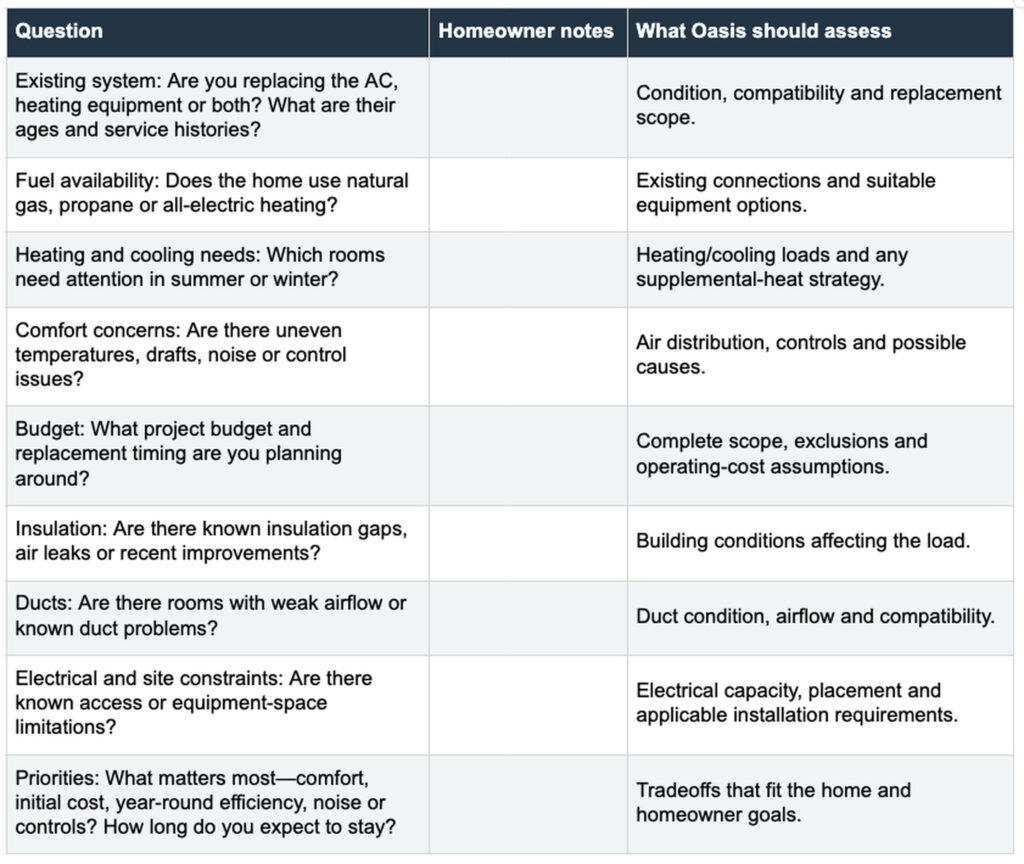

The assessment considers existing equipment and fuel, seasonal comfort needs, insulation and ducts, electrical and site conditions, project costs and personal priorities. The diagram illustrates planning factors; it is not a design for a particular home.
What to Ask When Reviewing the Options
Ask how each proposed configuration addresses the concerns in your worksheet. A useful explanation connects the recommendation to the home’s heating and cooling needs, existing equipment and installation conditions.
- How will you verify the heating and cooling capacity the home needs?
- If a heat pump is proposed, what performance data and supplemental-heat plan apply during colder conditions?
- If equipment will be retained, how will it work with the proposed replacement and controls?
- What duct, electrical, venting or other site work is included, and what is excluded?
- What assumptions about utility rates, operation and maintenance support any cost comparison?
ENERGY STAR’s air-source heat-pump buying guidance recommends professional sizing and consideration of cold-weather performance and potential backup heating. Those questions should be answered for the proposed equipment and your home, rather than with a generic rule.
Discuss the Next Step With Oasis
Use your notes to discuss heating repair and replacement options with Oasis. Share what you know about the system, the rooms that need attention and your timing. If you do not know the equipment details or fuel setup, you can still request help.
The worksheet prepares the conversation; a professional assessment should guide the equipment recommendation. Ask for the proposed scope and any additional work to be explained before making a decision.
Which Is Better for Your Central Texas Home?
For many Central Texas homes, a heat pump deserves a place on the replacement shortlist. It can handle summer cooling while also providing heating through much of the region’s heating season. But a furnace remains a practical and comfortable option for many homes, particularly when the existing fuel source and equipment setup make it the better fit.
The best decision starts with the home, not the equipment label. A qualified HVAC professional should evaluate the existing system, heating and cooling loads, ductwork, electrical capacity, fuel availability, and the homeowner’s priorities before recommending a replacement configuration.
Oasis Services helps Central Texas homeowners compare replacement options without forcing every home into the same solution. Explore our heating and furnace services, or review local HVAC service options for Buda, Bastrop, Kyle, and Austin.
Frequently Asked Questions
Are heat pumps good in Texas?
Yes, heat pumps can be a strong option for many Texas homes. Central Texas has a long cooling season and generally less heating demand than colder northern climates, but proper sizing and a plan for colder conditions are still important.
Is a heat pump better than a furnace?
Neither is universally better. The right choice depends on the home, existing equipment, fuel availability, utility costs, installation scope, comfort preferences, and the system design.
Does a heat pump replace both an AC and furnace?
A central heat pump can provide both cooling and heating, so it can replace the functions of a traditional AC plus a separate heating appliance in some homes. Other homes may use a heat pump with supplemental electric heat or a furnace in a dual-fuel configuration.
What is the difference between a heat pump and AC?
Both can cool a home by moving heat outdoors. A heat pump can reverse the refrigeration cycle to provide heating as well, while a standard central AC is cooling-only equipment.
Will a heat pump work during a Texas freeze?
Many modern heat pumps continue operating at low outdoor temperatures, but capacity and efficiency vary by model. The system may use supplemental or backup heat during the coldest conditions, depending on how it is designed.
Is a heat pump cheaper to run than a furnace?
It depends. Equipment efficiency, electricity and fuel rates, outdoor temperatures, home efficiency, system sizing, and supplemental heat use all affect operating cost.
Can I use a heat pump with a gas furnace?
Yes. A dual-fuel system can combine an electric heat pump with a furnace so the controls can use the appropriate heating source based on the system design and conditions.
Should I consider a heat pump when my AC needs replacement?
Yes. Because a heat pump also provides cooling, AC replacement is a natural time to compare a heat pump with a cooling-only AC, especially if the home’s heating equipment is also aging.
Talk With Oasis About Your Next HVAC System
If your AC, furnace, or entire HVAC system is approaching replacement age, compare the complete options before making a like-for-like replacement by default. Oasis Services can evaluate your home and explain where a heat pump, furnace, or dual-fuel system may fit your comfort and budget goals.
Ready to compare HVAC replacement options? Contact Oasis Services or call (512) 569-5957 to schedule an evaluation.